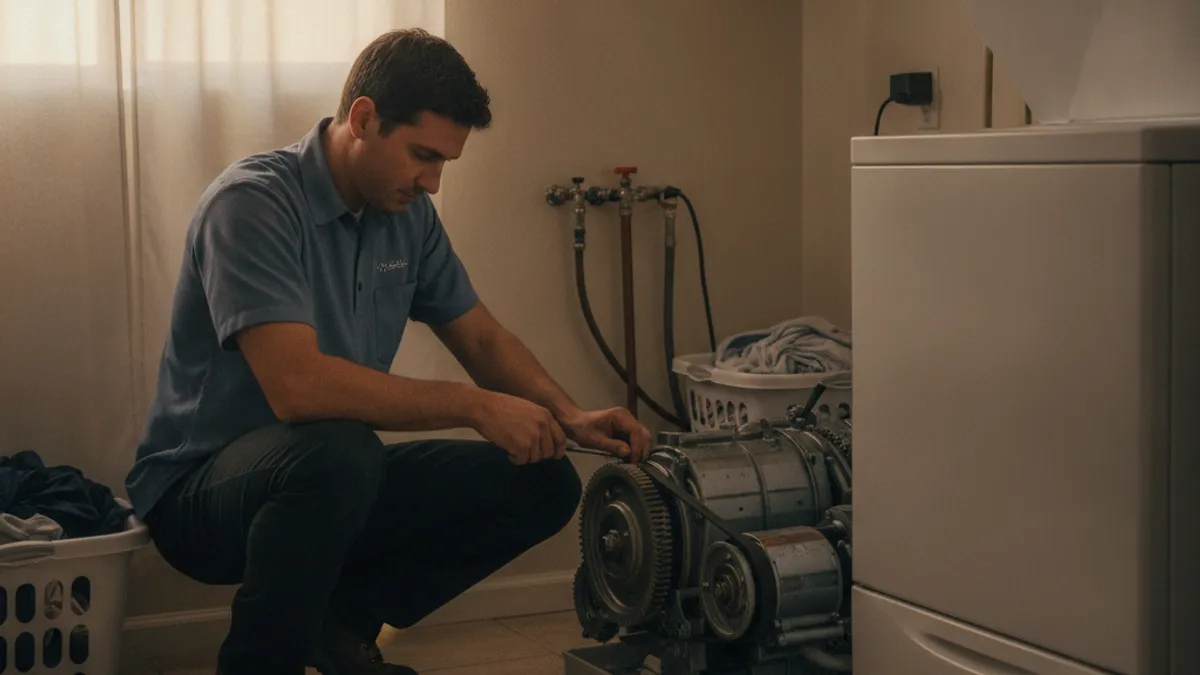
Speed Queen washers that will not spin, fill, or drain still follow the same owner notes: record the symptom and the model. Cost in San Diego follows relative factors in the table below, not a dollar table. The matched technician quotes in writing.
Why Speed Queen washers get called differently
A lot of Speed Queen’s top-load lineup still uses a mechanical, electromechanical timer dial rather than an electronic control board. That’s a deliberate design choice aimed at rental units and coin laundries, where a simpler machine means fewer things that can fail and easier field service. The tradeoff is that the timer itself, with its internal cams and switch contacts, is a wear part on high-cycle machines. After years of heavy use, contacts inside the dial can pit or the cam can wear, causing the machine to skip a cycle step or stop advancing partway through a wash.
Newer Speed Queen models do offer electronic controls, and those fail more like a typical modern washer, with sensor and board faults rather than mechanical timer wear. When you call, tell us whether your dial is a physical knob you turn or a digital display, since that changes what the technician checks first.
Common Speed Queen washer problems
Washer won’t advance through the cycle. On mechanical-timer models, this is usually the timer motor or the cam contacts inside the dial assembly. The machine will often sit at one step, like fill or agitate, and never move to the next.
Washer won’t fill or fills slowly. This points to the water inlet valve, the same part that fails on nearly every brand of washer. Mineral buildup from San Diego’s harder inland water supply, common in areas like Santee and El Cajon, can also restrict flow through the valve screens over time without a full failure.
Washer agitates or spins but clothes don’t move. On agitator-style Speed Queen models, this usually means the drive block, sometimes called agitator dogs, has worn down and is spinning freely instead of engaging the tub. This is the same failure that shows up across most agitator-style top-loaders regardless of brand, and it’s a straightforward repair once confirmed.
Excess noise or vibration during spin. Some Speed Queen models use a simpler, more rigid suspension setup than many competing brands, which is part of what gives them their heavy-duty feel. That also means a washer that isn’t sitting level, or one loaded unevenly, tends to transmit more noise and vibration than a softer-suspended machine would. Leveling the feet and rebalancing the load solves a large share of these calls before any part needs replacing.
Leaking water. Usually the same suspects as any washer: a worn drain hose connection, a cracked tub-to-pump hose, or a door boot seal on front-load models. The technician traces the leak to its source before opening anything up, since a leak at the connection looks identical to a leak from a cracked internal hose until you look closely.
What drives the cost of a Speed Queen repair in San Diego
| Issue | Relative cost |
|---|---|
| Water inlet valve replacement | Low to moderate |
| Timer/cam assembly repair | Moderate |
| Drive block (agitator dogs) replacement | Moderate |
| Leveling and load-balance visit | Low |
| Drain hose or pump hose replacement | Low to moderate |
| Transmission service (heavy-use units) | Highest of the group |
Ask the technician about their diagnostic fee and whether it’s credited toward the repair.
Because these machines run so many more cycles over their life than a typical residential washer, especially in shared laundry rooms and rentals, the parts that do wear tend to be the ones built for high cycle counts, like the transmission and timer, rather than the electronics that fail first on smart washers.
For general washer troubleshooting across brands, see our washing machine repair service page. For comparing wash mechanisms if you’re deciding between a new agitator or impeller machine, see our guide to impeller versus agitator washers.
Frequently asked questions
Why does my Speed Queen washer stop mid-cycle?
On mechanical-timer models, this usually points to worn contacts or a failing cam inside the timer dial assembly. The machine gets stuck at one step of the cycle instead of advancing normally. It’s a repairable part, not a sign the whole machine needs replacing.
Are Speed Queen washers harder to repair than other brands?
Generally the opposite. Their simpler mechanical design on many models means fewer electronic boards to diagnose, which often makes the actual repair faster once the failed part is identified. The tradeoff is that mechanical timer parts wear out from cycle count over a long service life.
Why is my Speed Queen washer so loud during the spin cycle?
Check that all four feet are adjusted so the machine sits level and doesn’t rock when pushed at each corner. Some models use a firmer suspension design than typical residential washers, so an unlevel or unbalanced load is more noticeable as noise and vibration than it would be on a softer-mounted machine.
How long do Speed Queen washers typically last?
These machines are built for heavy-cycle use in rental and commercial settings, so with normal home use many run well past the point where a typical residential washer would need replacement. Actual lifespan varies by model and how hard the machine is run.
When to call us
Call us when your Speed Queen washer won’t advance through its cycle, won’t fill, agitates without moving clothes, or has developed a leak. Have the model and serial number from the tag on the back or inside the lid ready when you call, since it helps the technician identify the platform. Call (858) 988-7787 to leave a voicemail requesting a match.