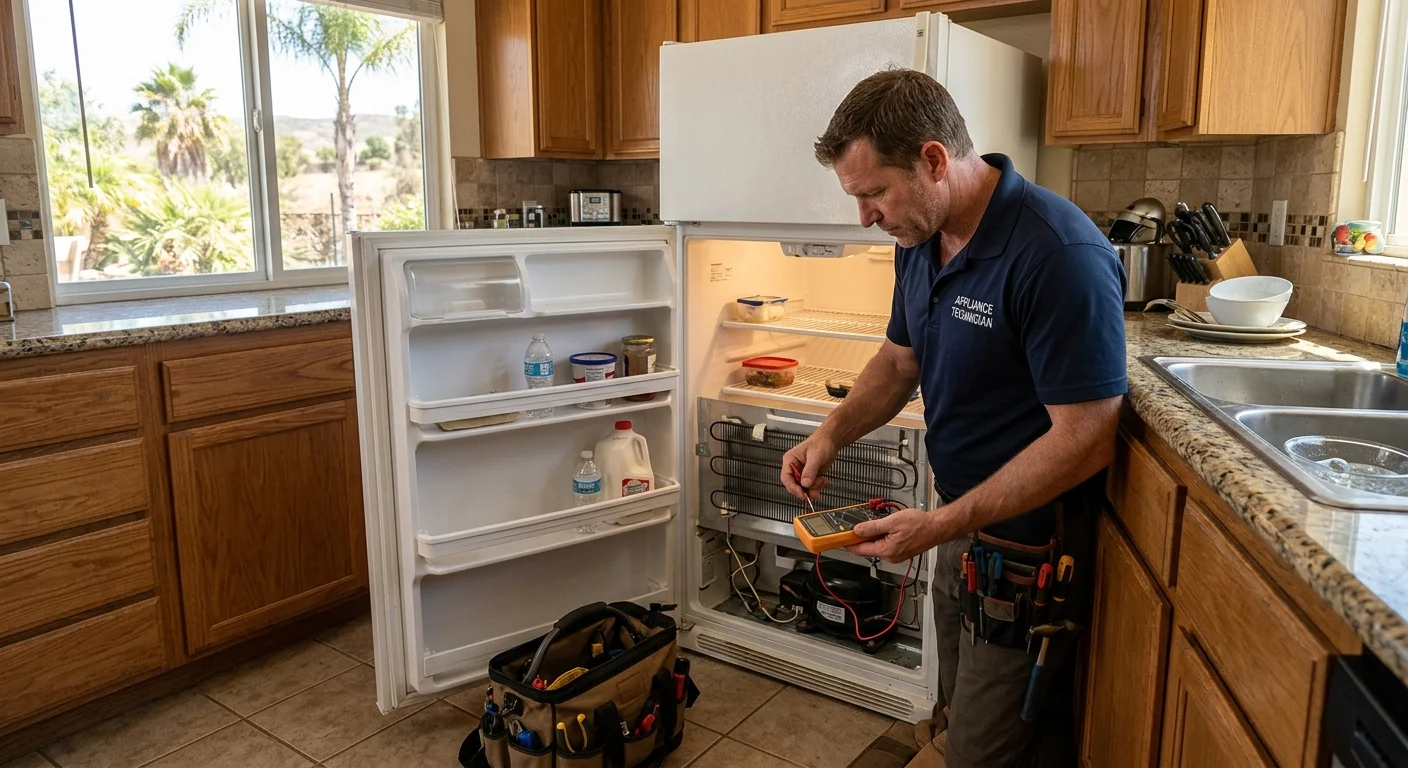
A warm refrigerator needs a methodical check, not a guessed part. Start by protecting food, comparing both compartments, and recording what changed. Those details help an Escondido refrigerator repair technician diagnose the problem.
Identify the exact cooling pattern
“Not cooling” can describe several different problems. The refrigerator may feel warm while the freezer remains cold. Both compartments may be warming, or temperatures may rise and fall throughout the day.
Check each compartment with an appliance thermometer. FDA guidance keeps refrigerators at or below 40°F and freezers at or below 0°F. A practical refrigerator target is about 37°F, but the hard food-safety ceiling remains 40°F.
Write down the measured temperature, time, and thermometer location. The refrigerator door is usually the warmest area, while lower areas are colder. Avoid treating one door-shelf reading as the whole refrigerator’s condition.
Also record these observations:
- Whether the freezer still freezes food
- Whether the problem is constant or intermittent
- Whether interior lights and controls work
- Whether you hear new clicking, buzzing, or silence
- Whether frost appears on an interior panel
- Whether water or ice has appeared beneath the appliance
- Whether the doors close fully without pressure
These details don’t identify a failed component by themselves. They give the technician a useful starting point for testing.
Food history matters too. The FDA says perishables held above 40°F for more than two hours should be discarded. That window becomes one hour when the surrounding temperature exceeds 90°F. Keep a written temperature timeline when possible.
Our broader fridge cooling checklist can help you organize those first observations. It also helps separate a confirmed temperature problem from one warm container or one frequently opened door.
What owners can check without opening components
Stay with visible checks that don’t require removing service panels. Begin by confirming that the refrigerator has power. Look for working lights, an active display, and a firmly seated plug you can reach safely.
Check the control panel against the manufacturer’s instructions. A control may have been changed during cleaning, loading, or a brief power interruption. Some models also have special cooling, vacation, or showroom settings. Use the model’s manual because control sequences differ.
Next, inspect how food is arranged. Packages shouldn’t press against interior air openings. A crowded shelf can also prevent a door from closing. Remove anything caught between the door and cabinet.
Look along the gasket for visible debris, folds, gaps, or torn material. Clean only as directed by the manufacturer. Then close the door and confirm it remains shut without being held.
Check the space around the appliance. Make note of anything recently stored beside, behind, or above it. If the manual calls for cleaning an accessible grille or condenser area, follow exact instructions. Don’t remove covers to reach internal wiring, fans, or sealed components.
A recent outage also changes the next step. Keep doors closed while temperatures recover. FoodSafety.gov guidance says a full freezer can hold temperature for about 48 hours during an outage when unopened. A half-full freezer can hold it for about 24 hours.
Find the model and serial labels before requesting service. You can also search that information through the Consumer Product Safety Commission recall database. Don’t assume a symptom proves that your model is recalled.
Stop the owner checks if they require moving a built-in appliance, handling wiring, or opening a sealed area. Record what you found and leave component testing to the matched technician.
What technicians inspect during diagnosis
A technician should confirm the complaint before recommending a repair. That starts with measured temperatures and the pattern you recorded. The technician can then compare actual operation with the manufacturer’s specifications.
The inspection may include controls, sensors, fans, switches, door seals, air passages, and accessible condenser components. The technician may also check for frost patterns and test electrical parts. Which tests matter depends on whether one or both compartments are warm.
This process prevents a common mistake: choosing a part from one symptom. A clicking sound, warm shelf, or frosted panel can guide testing. It doesn’t prove which component failed.
If testing points toward the compressor or refrigerant circuit, the job becomes sealed-system work. Technicians who service equipment containing covered refrigerants must hold the appropriate EPA Section 608 certification. Ask the technician about that credential before approving refrigerant work.
California appliance repair businesses must register with the Bureau of Household Goods and Services. Registration is separate from a contractor license and doesn’t demonstrate technical competency. You can check a business through the state’s Department of Consumer Affairs license lookup.
The technicians in our network are licensed and insured independent professionals. Repair Pro San Diego makes the referral. It doesn’t diagnose appliances, employ technicians, stock parts, or perform repairs.
Pricing depends on the diagnosis, appliance design, required part, and access. The matched technician diagnoses first and quotes in writing before work begins. Ask about the diagnostic fee, whether it’s credited toward approved work, and what the technician’s written warranty covers.
For more detail about available service, visit our refrigerator and freezer repair page.
Which Escondido property details should be recorded
The technician needs more than the city name. An Escondido address could be near Grand Avenue, North Broadway, Kit Carson Park, or the I-15 and SR-78 junction. Give the exact service address and practical access notes when requesting a match.
Record the property type, including whether it’s a house, condo, apartment, or accessory dwelling unit. Note the refrigerator’s floor and any stairs, gates, elevators, narrow entries, or parking instructions. These details help the independent technician prepare for access without creating an arrival promise.
Describe the installation itself. State whether the refrigerator is freestanding, counter-depth, built into cabinetry, or covered by custom panels. Measure only what you can reach without moving the appliance.
Mention whether the refrigerator has:
- A connected water supply
- An ice maker or door dispenser
- Custom cabinet panels
- Tight side or overhead clearances
- A nearby wall that limits door movement
- A separate freezer drawer or multiple cooling zones
The appliance’s location also matters. Say whether it’s in the kitchen, garage, guest unit, office, or another room. Record any recent cabinet work, flooring changes, appliance movement, plumbing work, or electrical interruption. Don’t guess about a connection. Simply report what changed and when.
Avoid making assumptions from neighborhood or building age. If you know the original construction year or kitchen remodeling date from property records, include it. Also mention any known changes to the outlet, water line, cabinetry, or floor beneath the refrigerator.
Take clear photos of the model label, control display, interior frost, door alignment, and visible water. Those images help communicate the symptom, though they don’t replace hands-on testing.
Our Escondido appliance repair guide covers the broader matching process for other household appliances in the city.
How to request a matched refrigerator technician
A useful service request begins with the appliance identity. Provide the brand, full model number, and approximate purchase date if known. Copy the model number from the label instead of relying on a receipt description.
Next, describe the cooling pattern in plain language. For example, state that the freezer measures 0°F while the refrigerator measures above 40°F. Include when you first noticed the change and whether the temperature has stayed steady.
Your request should also cover:
- Current refrigerator and freezer temperatures
- Any displayed error code
- New sounds, frost, leaking, or odors
- Recent outages or control changes
- Whether the appliance is built in
- Water and ice-maker features
- Property access or parking instructions
- Any manufacturer warranty or service-plan documents
Don’t clear an error code before recording it. Photograph the complete display and note what the refrigerator was doing. If you already tried a manufacturer-approved reset, say when and describe the result.
Repair Pro San Diego uses these details to help match you with an independent local technician. The voicemail starts the referral request. It isn’t a remote diagnosis, repair approval, or promise of an appointment window.
The matched technician sets their own diagnostic process, availability, fees, and warranty terms. Ask for those details directly and get the repair quote in writing before work begins. If sealed-system work is proposed, confirm the technician has the appropriate EPA Section 608 certification.
Homeowners comparing needs across the county can also read our San Diego refrigerator repair guide. It explains what information helps before a technician evaluates the appliance.
When to call us
A refrigerator that remains warm after visible checks needs an appliance repair professional to diagnose it. Call (858) 988-7787 to leave a voicemail requesting a match with a local appliance repair pro.