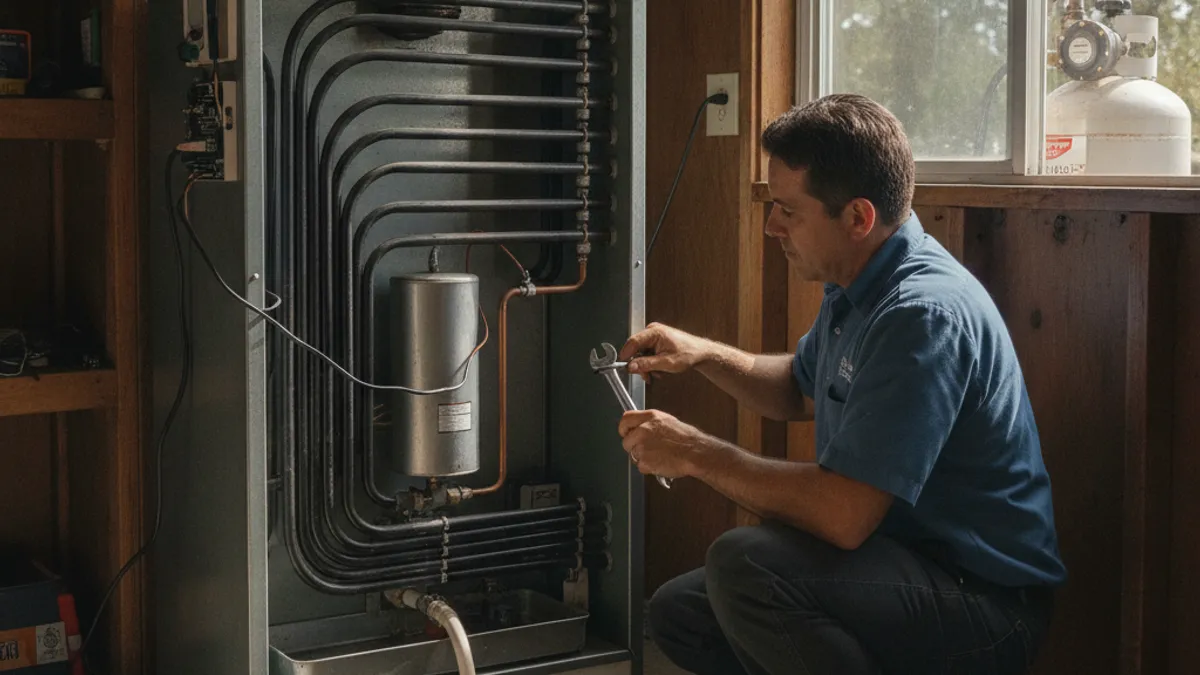
Most of San Diego County runs standard electric refrigerators, but out past the water and power lines, in the ranch properties and off-grid parcels around North County’s rural edges, propane refrigerators are still doing daily work. These are a different animal mechanically, and a tech who’s only ever worked on standard compressor fridges can misdiagnose them badly.
How a propane refrigerator actually works
A standard refrigerator uses a compressor to push refrigerant through a cycle of compression and expansion, the same basic principle in every home fridge, window AC unit, and car air conditioner. A propane refrigerator uses something completely different: an absorption cycle. A small propane flame, or an electric heating element on dual-fuel units, heats a sealed mixture of ammonia, water, and hydrogen gas. That heat drives the ammonia through a cycle of evaporation and absorption that produces cooling, with no compressor and no moving parts in the cooling system itself.
That’s the appeal for rural and off-grid properties. These units can run entirely on propane, without drawing meaningful electricity, which matters on a well-and-septic property running on generator or solar power where the fridge would otherwise be one of the biggest single electrical loads in the house.
Why these units fail differently than a standard fridge
The cooling unit needs to be level. Because the absorption cycle relies on gravity to move the ammonia solution through the system rather than a pump, a unit that isn’t sitting reasonably level won’t cool properly, or won’t cool at all. This is one of the most common calls we get on these units, and it’s often not a mechanical failure. A fridge that used to run fine and suddenly isn’t cooling is worth checking with a level before assuming a part has failed, especially after the unit has been moved or the flooring has settled, which happens on older rural properties more than people expect.
The sealed cooling unit itself can degrade over years of heat cycling. The boiler tube and the rest of the sealed ammonia system take direct heat every time the burner runs, for years on end. Eventually the tube can develop a crack or the internal chemistry can break down, sometimes visible as yellowish staining or corrosion on the black cooling fins at the back of the unit. Unlike a compressor fridge, where a refrigerant leak can sometimes be found and repaired, a failed absorption cooling unit generally can’t be recharged in the field. At that point, the cooling unit itself needs replacement rather than a recharge or patch.
The burner and flue can clog. The propane burner orifice is a small opening, and dust, and in outdoor or semi-enclosed installations, insect nests, can partially or fully block it over time. A partially blocked orifice or flue produces incomplete combustion, which shows up as a weak, lazy, or yellow-tinged flame instead of a crisp blue one. That’s not just a cooling problem. A yellow or sooty flame on any propane appliance is a sign of incomplete combustion, which increases carbon monoxide output, and it’s worth treating as a safety issue, not just a performance one. If you see a yellow flame instead of blue, shut the appliance down and have a qualified propane technician inspect it before running it again, and make sure the space has a working carbon monoxide detector regardless.
The thermostat and gas control valve can fail. Same as any gas appliance, the thermostat that regulates flame output and the gas control valve that opens and closes the propane supply to the burner are mechanical parts that wear out over years of service.
What appliance techs handle versus what needs a propane specialist
The technicians in our network repair and service the refrigerator side of these units: the thermostat, the burner assembly and orifice, the ignition system, and diagnosing whether a cooling unit has failed and needs replacement. Work on the propane supply line itself, the tank, the regulator, or fixed gas piping to the appliance, falls to a licensed propane or gas contractor, and they’ll tell you plainly when that’s what you need rather than trying to stretch past what the appliance-side repair covers.
For rural and backcountry properties in North County and beyond, techs in the network do travel for these calls, though scheduling can take a bit longer than in the more populated parts of the county given the distances involved.
Frequently asked questions
Why did my propane refrigerator suddenly stop cooling?
Check that the unit is level first, since the absorption cycle depends on gravity rather than a pump to circulate the ammonia solution. If it’s level and still not cooling, the burner may be clogged, the thermostat may have failed, or the sealed cooling unit itself may have degraded.
Can a propane refrigerator’s cooling unit be recharged if it fails?
Generally no. Unlike a compressor-based refrigerator where a refrigerant leak can sometimes be found and repaired, a degraded absorption cooling unit usually needs full replacement rather than a recharge, since the sealed system isn’t designed to be serviced in the field.
What does a yellow flame on my propane refrigerator mean?
A yellow or orange flame instead of a crisp blue one indicates incomplete combustion, often from a partially clogged burner orifice or flue. Treat this as a safety issue: shut the unit down and have a qualified propane technician inspect it, and confirm you have a working carbon monoxide detector nearby.
Do you work on propane refrigerators in San Diego’s backcountry areas?
Yes, techs in our network work on propane and dual-fuel absorption refrigerators throughout San Diego County, including rural and off-grid properties. They handle the appliance itself; propane tank, regulator, and supply line work goes to a licensed propane contractor.
When to call us
Call us if your propane refrigerator has stopped cooling, the flame looks yellow instead of blue, or you’re seeing staining or corrosion on the cooling fins at the back of the unit. Call (858) 988-7787 to schedule a diagnostic visit.