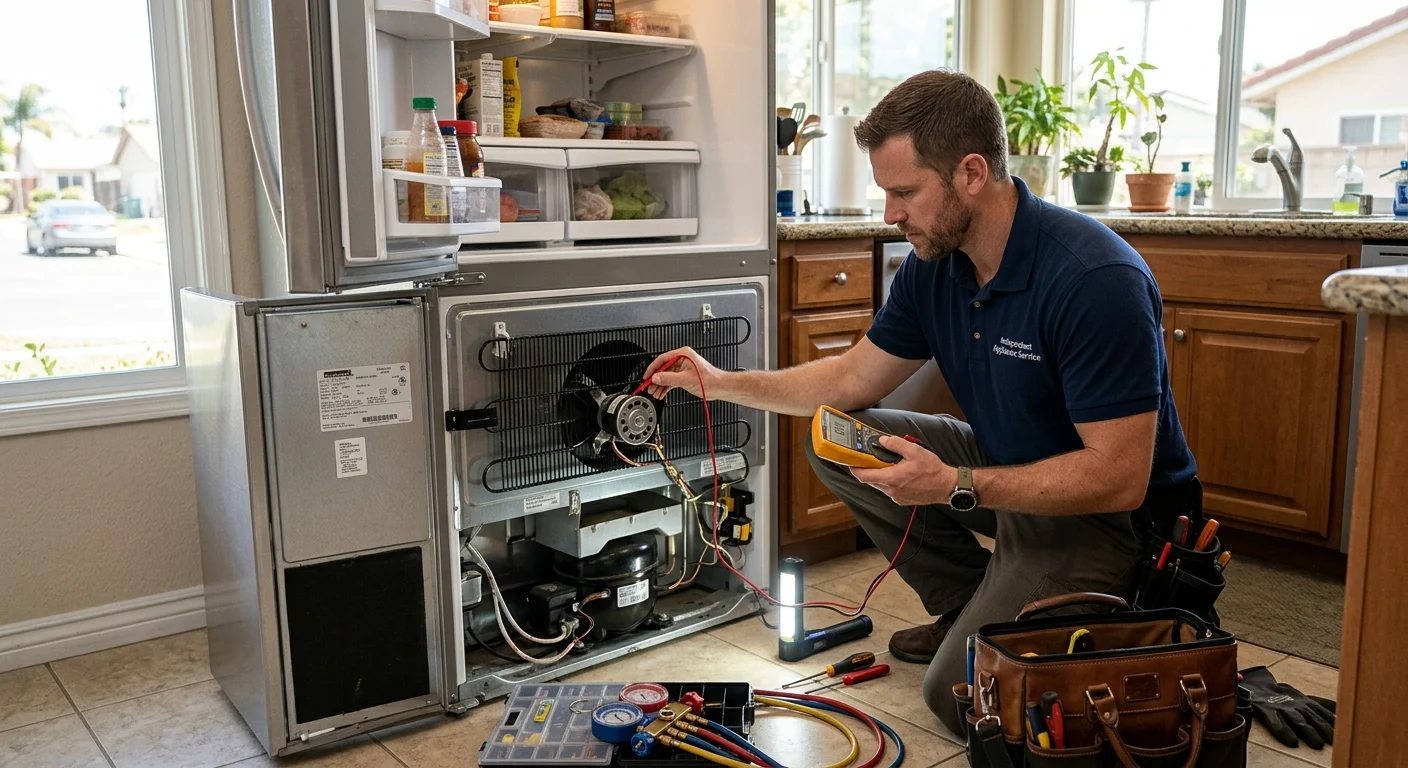
A Kenmore refrigerator freezer repair starts with one observation: which compartment is warm. Compare the refrigerator and freezer, then note whether cooling stopped suddenly or faded over time. Those details help a technician choose the right diagnostic path.
Start with the model and cooling pattern
Record the full model number before requesting Kenmore refrigerator repair. The Kenmore name alone doesn’t identify the refrigerator’s exact controls or component layout. A technician needs the complete identifier from the appliance’s rating label.
Copy every letter, number, dash, and period. A clear photo helps prevent transcription mistakes. Keep the serial number available too. Your model’s manual should show where its rating label is located.
Next, describe what each compartment is doing. Useful cooling patterns include:
- The refrigerator is warm, but the freezer still freezes food.
- Both compartments are warmer than their settings.
- The freezer is cold near one area but soft elsewhere.
- Cooling returns briefly, then fades again.
- Frost appears on an interior panel.
- Fans, clicks, buzzing, or long quiet periods sound unusual.
- The display shows a code or unexpected temperature.
Don’t assign a cause from one symptom. Several components can produce similar cooling patterns. Instead, photograph the display and any visible frost. Note whether the doors recently stayed open, the appliance was moved, or food blocked an interior vent.
Placement also matters to the diagnostic conversation. A refrigerator in an East County garage has different surroundings than one inside a City Heights apartment. A tightly enclosed cabinet in a coastal North County kitchen presents another setup. Tell the technician where the appliance sits and how much open space surrounds it.
For broader brand coverage, see our Kenmore appliance repair guide for San Diego. This page stays focused on refrigerator and freezer cooling.
What owners can check without opening components
Keep your first check outside the refrigerator’s service panels. Begin with the display, settings, doors, food placement, and visible airflow openings. Use the exact model manual when a control label isn’t clear.
Confirm that the refrigerator has power. Check whether its interior lights and display operate. Then read the current settings without changing several controls at once. Photograph them first. If someone recently changed a setting, the photo gives the technician a useful reference.
Inspect both doors from top to bottom. Look for a package, drawer, shelf, or bin stopping either door from closing. Check the visible gasket for folds, gaps, debris, or damage. Don’t assume a closed-looking door has made full contact around every edge.
Inside each compartment, find the visible air openings described in the manual. Move packages that directly cover them. Don’t remove an interior panel to search for hidden ice or a fan.
Use an appliance thermometer to document actual conditions. FDA guidance sets the refrigerator ceiling at 40°F and the freezer at 0°F or below. The FDA also says to discard perishables held above 40°F for more than two hours. That window drops to one hour when the surrounding temperature exceeds 90°F.
Write down the thermometer reading and the time. Avoid repeated door opening while you’re tracking cooling. Our fridge not cooling checklist covers additional observations that apply across brands.
These checks may reveal a door or airflow issue. They don’t confirm that an internal part has failed. If the readings remain unsafe or the pattern returns, preserve your notes for the technician.
What technicians inspect in the cooling system
The technician starts by confirming the complaint against the model information and actual temperatures. From there, the inspection follows the symptoms instead of a guessed part.
When the freezer remains cold but the refrigerator warms, the technician may inspect air movement between compartments. That can include the evaporator fan, air passages, controls, sensors, and any visible frost pattern. The exact arrangement depends on the model.
When both compartments are warm, the diagnostic path may include the condenser area, fans, temperature-sensing components, compressor-starting components, and electronic controls. The technician can compare what the refrigerator is being told to do with what its cooling system is actually doing.
A frost-covered interior panel may lead to checks of the defrost components. A clicking or buzzing complaint may shift attention toward starting components or a fan obstruction. These observations narrow the test sequence, but they aren’t a reliable diagnosis by themselves.
Some cooling failures involve the sealed system. That category includes the compressor, refrigerant circuit, and related tubing. Under federal requirements, technicians who service equipment containing regulated refrigerants must hold the appropriate EPA Section 608 certification. Ask the independent technician about that credential before authorizing refrigerant work.
Don’t request a specific component based only on an online symptom match. A fan, sensor, control, defrost component, or sealed-system issue can require a different repair path. Testing first helps avoid ordering a part that doesn’t address the failure.
The matched technician diagnoses first and quotes in writing before work begins. Repair Pro San Diego doesn’t set diagnostic charges, parts prices, labor rates, or payment terms.
How freezer symptoms help narrow the problem
The freezer often provides the most useful comparison point. Describe whether it keeps food fully frozen, feels merely cool, or has stopped cooling with the refrigerator. Include where you measured the temperature and when.
If the freezer stays at or below 0°F while the refrigerator exceeds 40°F, tell the technician those exact readings. The inspection may focus on how cold air reaches the fresh-food compartment. Visible frost, blocked openings, or a fan that isn’t heard can add context without proving the cause.
If both sections warm together, report whether the change was sudden or gradual. Also note whether the appliance runs continuously, cycles, clicks, or stays quiet. Record those observations rather than trying to interpret them.
Uneven freezer conditions matter too. Frozen items near one wall and soft packages elsewhere create a different pattern than uniform warming. Take a photo before rearranging the compartment. Heavy loading or packages against visible air openings should also be mentioned.
Ice maker behavior can offer supporting context, but it shouldn’t become the diagnosis. Report whether ice production changed around the same time as cooling. Likewise, water on the floor, frost, or unusual noise belongs in the service request.
San Diego’s local conditions can shape what you report. Note whether the refrigerator sits in a hot inland room, an enclosed cabinet, or an unconditioned garage. Don’t assume the location caused the failure. It simply gives the technician a clearer picture.
Keep the doors closed while protecting food. During an outage, federal food-safety guidance says a full freezer can hold temperature for about 48 hours when unopened. A half-full freezer holds it for about 24 hours. Food may be refrozen when a thermometer still reads 40°F or below.
When to request Kenmore refrigerator repair
Request professional diagnosis when basic exterior checks don’t restore stable cooling. The same applies when temperatures improve briefly and then rise again. Recurring frost, unexplained water, unusual sounds, or warming in both compartments also deserve a model-specific inspection.
Have these details ready:
- The complete model and serial numbers
- Refrigerator and freezer thermometer readings
- When the cooling change began
- Whether one or both compartments are affected
- Photos of the display, settings, frost, or water
- Any recent move, outage, door problem, or control change
- The refrigerator’s location and surrounding clearance
Repair Pro San Diego can match you with a licensed and insured independent technician for refrigerator and freezer repair across San Diego County. The matched pro performs the diagnosis and repair. The referral service doesn’t perform physical work or provide its own repair warranty.
California requires appliance repair businesses to register with the Bureau of Household Goods and Services. You can check a business through the state’s Department of Consumer Affairs lookup. That lookup confirms registration status, not an individual technician’s technical ability.
Check the exact model through the CPSC recall database if you suspect a current safety notice. Don’t assume a cooling failure means the refrigerator was recalled.
North County homeowners can also read our Oceanside appliance repair guide for local matching information. Wherever you’re located, ask the technician to put the diagnosis, proposed work, price, and any repair warranty in writing before work begins.
When to call us
Persistent warming, recurring frost, internal component testing, or sealed-system work calls for a licensed and insured local appliance repair pro. Repair Pro San Diego can take your voicemail and use the details to help arrange an independent match.
Call (858) 988-7787 to leave a voicemail requesting a match with a local appliance repair pro.