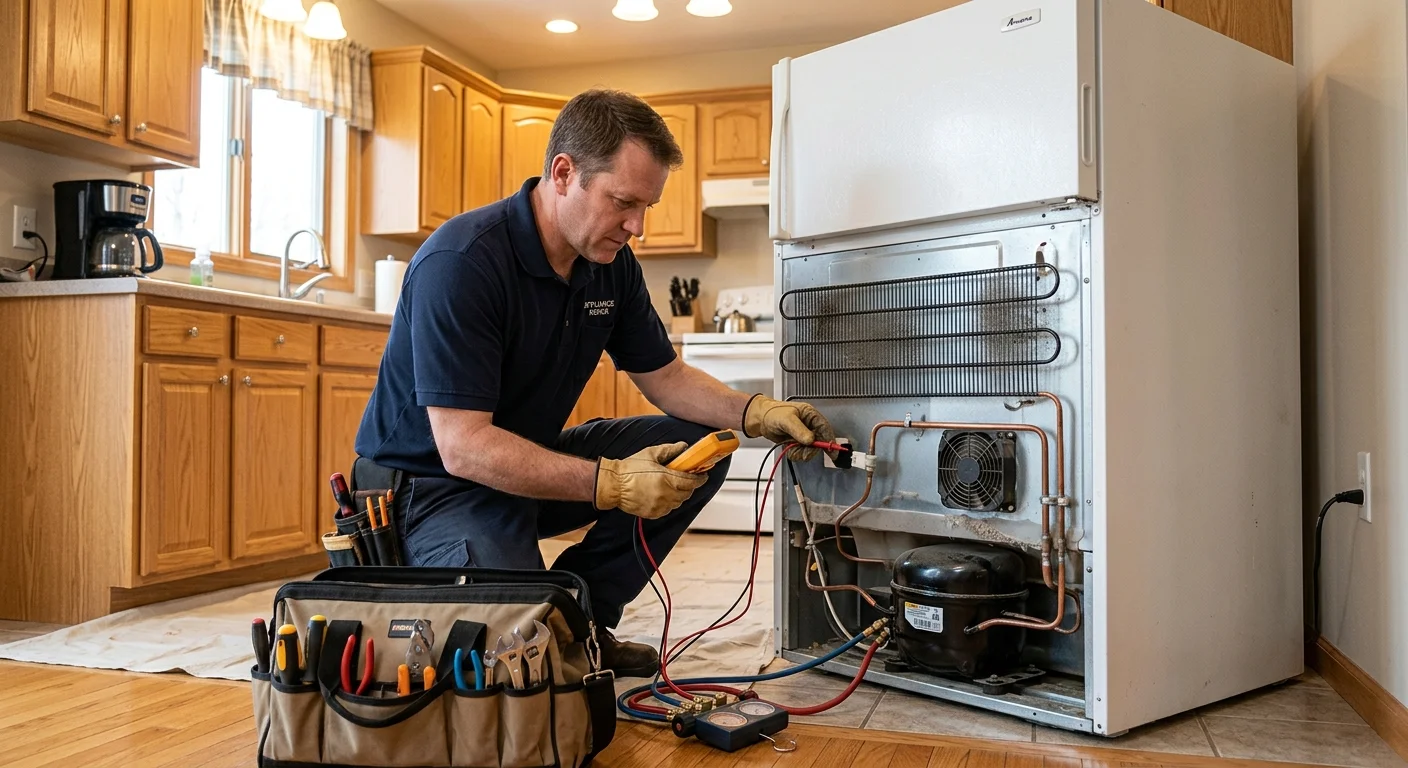
When an Amana refrigerator stops cooling, first confirm which compartments are warm. The right Amana refrigerator freezer repair depends on that pattern and the exact model. Check settings, doors, airflow, and recorded temperatures before a technician diagnoses internal components.
Confirm the model and cooling pattern
Start with the model number, not the appliance’s appearance. Amana has used different controls and cabinet layouts across its refrigerators. Advice for another model may send you toward the wrong setting or component.
Find the model and serial label inside the cabinet or near a door opening. Its location varies, so check the owner’s guide if it isn’t obvious. Photograph the complete label. A partial model number can point to the wrong parts information.
Next, document what the refrigerator is doing. Use an appliance thermometer instead of judging food by touch. The FDA says the refrigerator compartment should stay at or below 40°F. The freezer should stay at or below 0°F.
Record both readings and note where you placed each thermometer. Also write down these details:
- Whether the fresh-food compartment, freezer, or both feel warm
- Whether interior lights and controls still work
- Whether you hear a fan, hum, click, or unusual silence
- Whether frost or ice appears on an interior panel
- Whether the doors close without resistance
- Whether the problem is constant or comes and goes
These observations don’t establish the cause. They give the technician a useful starting point.
Check the owner’s guide for the exact model before changing settings. If you can’t find verified Amana instructions, don’t borrow a reset sequence from another model. Give the matched technician the model number and cooling pattern when requesting Amana refrigerator repair.
What owners can check without opening components
Keep the first checks outside sealed panels and electrical compartments. Confirm that the refrigerator has power. Look for illuminated controls and listen for normal operating sounds. If the display shows a message or code, photograph it before changing anything.
Review the selected temperature settings against the model’s owner’s guide. A control can be moved during cleaning or loading. Some models also have operating modes that change normal cooling behavior. Use only instructions written for your model.
Then inspect the doors. A food container, drawer, or shelf can prevent a complete seal. Check the full gasket for folded areas, gaps, debris, or visible damage. Close each door gently and watch whether it rebounds or remains seated.
Look inside for crowded shelves or packages pressed against visible air openings. Cold air needs a path between compartments. Move only the items blocking those openings. Don’t dismantle ducts or interior covers.
Check the surrounding area without moving a heavy refrigerator alone. Visible dust around an accessible exterior grille can be recorded for the technician. Don’t remove a panel to reach hidden coils, fans, or wiring.
Our broader fridge not cooling checklist can help you organize these observations. The FDA says refrigerated perishables held above 40°F for more than two hours should be discarded. That limit becomes one hour when the surrounding temperature exceeds 90°F.
If you’re concerned about a product safety notice, search the exact model through the CPSC recall database. Don’t assume a similar-looking refrigerator has the same notice.
What technicians inspect in the cooling system
When exterior checks don’t explain the problem, the diagnosis moves inside the appliance. The exact sequence depends on the model, symptoms, and recorded temperatures. A competent technician tests before recommending a part.
The technician may inspect airflow through the fresh-food and freezer compartments. That can include the evaporator fan, condenser fan, air passages, and door switches. A stalled fan or restricted passage can change how cold air reaches each section.
Frost location also matters. The technician may examine the evaporator area and defrost components. The pattern can help separate an airflow problem from a defrost or cooling-system concern. Frost alone doesn’t identify a failed part.
Electrical testing may cover temperature sensors, controls, relays, wiring connections, and compressor operation. Clicking, humming, or silence provides context, but sound isn’t a complete diagnosis. The technician should compare test results with service information for your exact Amana model.
Sealed-system work requires another qualification. Technicians who service equipment containing regulated refrigerants must hold the appropriate EPA Section 608 certification. Ask the technician whether that credential covers the work being proposed.
Repair Pro San Diego doesn’t diagnose appliances or perform these tests. We match customers with licensed, insured, independent local technicians. You can also check a service dealer through California’s Department of Consumer Affairs search.
Before authorizing work, ask what failed, how it was tested, and which part is being recommended. The matched technician diagnoses first and quotes in writing before work begins.
How freezer symptoms narrow the problem
The freezer’s behavior is one of the most useful clues. It won’t prove which component failed, but it helps define the technician’s inspection.
If the freezer stays cold while the refrigerator warms, document airflow between the compartments. Note blocked openings, unusual fan sounds, and frost on the freezer’s interior surfaces. Don’t assume the compressor has failed when one compartment still cools.
If both sections are warm, confirm the controls and power first. Listen for operating sounds and note whether they start, stop, or repeat. Tell the technician whether the temperature changed suddenly or declined over several days.
If frozen food is soft but the fresh-food section still seems cool, record actual thermometer readings. The freezer target remains at or below 0°F. A cold sensation from the air or packaging can hide a temperature problem.
Intermittent cooling deserves its own notes. Record the time, displayed code, temperature, and sound each time the condition returns. Include any visible frost before it disappears. That record is more useful than guessing which part is cycling.
Keep the freezer door closed while deciding how to protect food. According to federal food-safety guidance, a full freezer can hold its temperature for about 48 hours during an outage when kept closed. A half-full freezer holds it for about 24 hours. Food may be safely refrozen when a thermometer still reads 40°F or below.
For more symptom-based guidance, see our San Diego freezer repair guide. It explains how technicians approach frost, soft food, and unstable freezer temperatures.
When to request Amana refrigerator repair
Request repair when basic exterior checks don’t restore stable cooling. That includes recurring warm temperatures, unexplained frost, persistent control messages, unusual sounds, or a door that won’t seal correctly. Bring your notes, temperature readings, photographs, and complete model number.
Confirm that the matched technician works on your exact Amana model. Brand familiarity alone isn’t enough when controls and component layouts vary. Ask whether the proposed diagnosis requires model-specific service information or refrigerant work.
For refrigerator and freezer repair, Repair Pro San Diego makes the referral only. The independent technician evaluates the appliance, explains the findings, and provides the written quote. Ask that technician about any diagnostic fee before scheduling. Also ask whether that fee is credited toward an approved repair.
San Diego County conditions vary by location. A refrigerator in a hot Escondido garage faces a different setting than one inside a coastal kitchen. Tell the technician where the appliance sits, whether the space becomes warm, and whether the unit has enough visible clearance.
Homeowners in inland North County can also review our appliance repair guide for Escondido. Wherever you live, provide the full address and model before the referral. That helps identify a technician who serves your area and works on that appliance.
Don’t choose a repair from a symptom list alone. Several faults can create similar cooling patterns. Testing the actual refrigerator is what separates a useful diagnosis from a guess.
When to call us
Persistent warming, recurring frost, or internal component testing calls for a licensed Appliance Repair pro. Repair Pro San Diego can connect you with an insured independent technician who works on your exact Amana model. Leave a voicemail at (858) 988-7787 with your contact details, location, and Amana model number so we can follow up about a local technician.